


Inside Cassian Novara's most controversial work yet - a novel about transparency, power, and the one question every believer must answer: What does God ask us to do when seeing is not enough?
Did you know that we almost didn't publish this book?
Not because it's not good. It's extraordinary. Not because it's not timely - if anything, it's uncomfortably prophetic in ways that made our legal team nervous. We almost didn't publish it because Cassian Novara wrote something that refuses to choose between faith and revolution, between prayer and action, between "believing in God" and "changing the system."
And in a world that demands you take sides, that kind of ambiguity is dangerous.
The Story Behind the Story
When Novar first introduced this—eighteen months ago, in a Vienna café I won’t name—he described it as “a thriller about a man who learns that transparency without justice is just another form of cruelty.” I thought he was referring to the standard techno-ethical narrative. Maybe some Snowden parallels. The usual discourse on privacy versus accountability.
Then he sent me the opening chapter.
A boy on a hill in the Democratic Republic of Congo, watching trucks of diamonds pass by his village. His mother’s hands are aching from washing other people’s clothes for pennies that don’t add up to what the trucks haul in an hour. And when he asks her—this child, maybe eleven years old—“Where is God when justice is for sale?”
She doesn’t give him theology. She gives him testimony: “God sees. God remembers. God knows.”
I called him. “This is a spy thriller?”
“No,” Novar said. “It’s about what happens when that boy grows up and builds a system that allows everyone else to see what God sees. And then he has to decide if seeing is enough.”
I knew then that we were in trouble. The good kind.
The Uneasy Marriage of Prayer and Code
Here’s what makes this book controversial even before we get to the end: Mutombo—our protagonist, named after a fellow basketball player his mother once saw on grainy television—is explicitly a man of faith. Not in the way characters sometimes seem in fiction, where they mention God once and then go back to the action. Faith is the supporting infrastructure in this story.
He prays before big decisions. Not in vague spiritual contemplation—real prayer, on his knees, seeking the wisdom he knows he doesn’t have. When his mentor Umar teaches him the discipline of martial arts, the lesson isn’t just about physical control. It’s about understanding that power without accountability to something bigger than yourself is tyranny, whether that power comes from the fist or from code.
The most technically brilliant character—Wei, a Singaporean network architect who builds distributed infrastructure—speaks of silence as power in language that’s almost mystical. “Distributed systems are silent,” she says. “They whisper through the crowd instead of shouting from the stage. They’re harder to detect. They’re almost impossible to stop.”
She’s talking about peer-to-peer networks. She also describes how faith spreads.
Novar doesn’t explain the parallel because she expects you to see it for yourself.
Why this made our team uncomfortable
During the editing process, one of our readers—a sharp, secular person, the very demographic that buys literary thrillers—flagged multiple scenes. “Does it have to be so much prayer?” “Can we cut out some of the religious framework?” “Readers might find it alienating.”
I sent the manuscript to Novar with notes. He sent back one sentence: “Remove faith and you remove the foundation. The building will collapse.”
He was right.
Because this is what the book really asks: In a world where you can see everything—every corrupt transaction, every stolen dollar, every lie that props up the system—what is your responsibility? Is prayer enough? Is testimony enough? Or does faith require action?
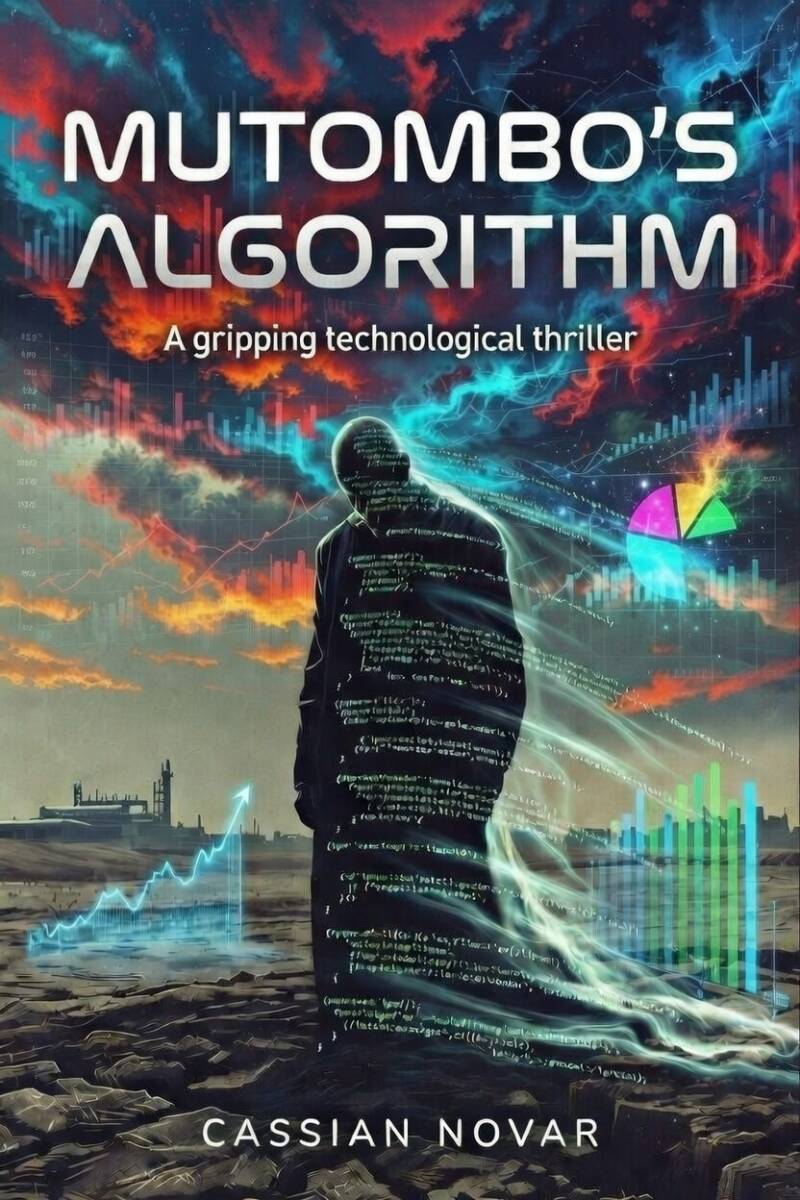
Mutombo grapples with this question throughout nineteen chapters. He builds EthicAiONE not to replace God’s judgment, but to make what God sees visible to people. Transparency as a form of testimony. Code as a witness.
But when transparency fails to bring justice—when people see corruption and shrug their shoulders, or worse, when they see it and decide that it’s simply the way the world works—what then?
That’s where the book becomes dangerous.
Technical That Becomes Spiritual
Novar did something smart that I didn’t fully appreciate until my second reading. Every technical detail in this book has a spiritual parallel.
The distributed network—thousands of nodes, no central authority, resistant to shutdown—reflects how faith survives across geography and persecution. You can’t kill an idea by destroying a headquarters that doesn’t exist.
The encryption that protects the system—fragmenting data so that no single node knows the whole truth—reflects how individual believers hold parts of revelation, and no one claims to see the whole of God’s plan.
The ethical framework that the philosopher Elias embeds in the code—automated filters that protect the innocent while exposing the guilty—is computational theology. The rules that try to approximate divine justice in silicon and electricity.
Is it perfect? No. Elias himself admits that the system makes mistakes. “We can program principles,” he says, “but context demands wisdom that we don’t have.”
Sound familiar?
A Team That’s Not a Team
One of the things readers tell us they love about them is the cast. These are not superheroes. They are experts broken by the same system they are trying to fix, each carrying their own relationship with power and God and the question of what they owe to something greater than themselves.
Nadia, a Moroccan whistleblower in exile, has learned that “transparency without protection is suicide.” She’s not speaking metaphorically—she’s alive because she knew when to hide and when to reveal. Her expertise in encryption comes from understanding that some truths need guardians.
Jonas, the departed Goldman Sachs analyst, has what he calls the “anatomy of sin” mapped out in his head—he can show you exactly how wealth flows from the poor to the rich, legally, systematically, eternally. His crisis is not ignorance. It is knowledge and the need to choose whether knowledge obliges action.
Sofia in Buenos Aires understands that “data without a story is noise”—that people need a narrative, need meaning, need to see themselves in the information before they will act on it. She doesn’t manipulate. She translates revelation into language that hearts can accept.
Wei in Singapore, who speaks infrequently but precisely, teaches Mutombo that “silence is power”—that the quiet persistence of distributed systems is more enduring than loud revolutions. She describes network architecture. She also describes how faith survives empires.
None of them start out as believers. Most end up thinking about things they haven’t yet. Not exactly converted. But unable to look at what they’ve built and see a purpose greater than the code.
The Love Story No One Expected
Chapter eleven introduces Inge, and here Novar does something I rarely see: he makes a romantic relationship the foundation of a mission rather than a complication.
Inge works to advocate for transparency. She knows the cost of telling the truth. When Mutombo besieges EthicAiONE, she doesn’t bring him back to “real life.” She asks him what he really wants—not as a crusader, not as a system builder, but as a man who will grow old and die and have to answer for how he spent his years.
“Do you want children?” he asks. Just like that, on a walk along the river in Frankfurt.
The question nearly crushes him. Because of course he does. And of course, the life he chooses makes it complicated, perhaps impossible.
But Novar doesn’t make him choose between mission and family. He makes him integrate them. By chapter eighteen, Inge is pregnant, and Mutombo realizes that building a better world is no longer abstract—it’s the world his child will inherit.
The prayer he then offers is the most sincere in the book: “Lord of all worlds, teach me to be a good father. Not perfect—I know perfection doesn’t exist. But good. Present. Honest.”
It’s the prayer of every parent who has ever tried to change something bigger than themselves while raising someone smaller.
## The Ending That Started the Fight
We argued for six weeks about chapter nineteen.
Novar wrote a perfectly good ending. Satisfying. The system is moving, the world is adjusting, Mutombo is coming to terms with having started something he can’t control. Mature. Realistic. Ready for publication.
Then he sent in a revision.
Mutombo is in the Congo. Inge is eight months pregnant. And he’s staring at the code for EthicAiONE version 2.0—not transparency this time, but redistribution. Two hundred billion dollars in proven stolen assets, automatically transferred to the world’s poorest citizens. No courts. No votes. No process.
Only what was taken is given back to you.
The theological question at the heart of the book: Does faith obligate action? If you can see injustice and have the power to correct it, does God expect you to intervene? Or is it a story of ego—the belief that you know better than the systems God allows to exist?
Novar won’t answer. The book ends with Mutombo saying “I don’t know” to the woman carrying his child, to the code waiting on the screen, to us.
Seven days to decide. Then the ability is gone forever.
Nevertheless, we published it.
Why this matters
We publish works that ask hard questions and trust readers to accept hard answers. But this book operates on a different frequency.
It doesn’t ask whether technology can fix systems. It asks whether people are meant to fix systems or merely bear witness to them. Is faith passive or active. Is the right response to seeing what God sees prayer or revolution or somehow both.
The controversy is not about the technicalities - although yes, we had programmers who tested whether the distributed architecture was theoretically sound. The controversy is about the claim at its core: that there is a Power greater than any human system, that this Power sees everything, and that knowing it changes what we are responsible for. Some readers will love the spiritual framework. Some will find it alienating. Both groups will have strong opinions about the nineteenth chapter.
That means Novar has done his job.

A sequel we probably shouldn't publish
Here's what no one outside of Dream Scribe knows yet: Novar is writing a second book.
It's called *Redistribution*.
If *EthicAiONE* made people uncomfortable, the sequel will infuriate them. Because Novar is not hedging. Mutombo makes a decision. The world reacts. Systems collapse or transform or both.
And the spiritual question becomes more acute: If you believe that God has placed you in a position to act - given you the knowledge, the tools, the moment - is refusing to act the same as complicity?
Or is taking action a sin of pride - believing that you can improve on what God allows?
There's no sure answer. Novar knows it. We know it.
We're publishing it anyway, probably sometime next year, assuming our legal team doesn't give up before then.
What We Want You to Know
This is not a Christian book or a Muslim book or a book of any particular denomination, although Mutombo’s faith evolves toward Islam, and his prayers echo through traditions. It is a book about what happens when you take seriously the idea that power—any power—must be accountable to something greater than itself.
The Code is accountable to ethical principles. Principles are accountable to human dignity.
Human dignity is accountable to… what?
That is the question *EthicAiONE* asks on every page.
Novar’s answer—or non-answer—is that there is a Power greater than any system we construct. Call it God, call it the divine, call it the ultimate foundation of being. Whatever you call it, the book insists that this Power sees all, remembers all, and somehow that seeing changes what we are called to do with what we see.
Is it controversial? Absolutely.
Is the sequel even more controversial? You have no idea.
Should you still read it?
Yes. You should.
Because in a world drowning in information and starving for wisdom, in a time when everyone has an opinion and no one has the answers, in an era when systems seem too big to change and faith too small to matter—this book says: What if you’re wrong? What if seeing is *the* beginning, not the end? What if God gives us eyes not to judge but to act?
And what if acting looks like building distributed systems that can’t be shut down, writing code that protects the weak, bearing witness that refuses to look away, and somehow, through it all, praying for the wisdom to know when to serve justice and when to serve pride?
I don’t have an answer.
Neither does Novar.
Maybe that’s why we’re publishing this.
