

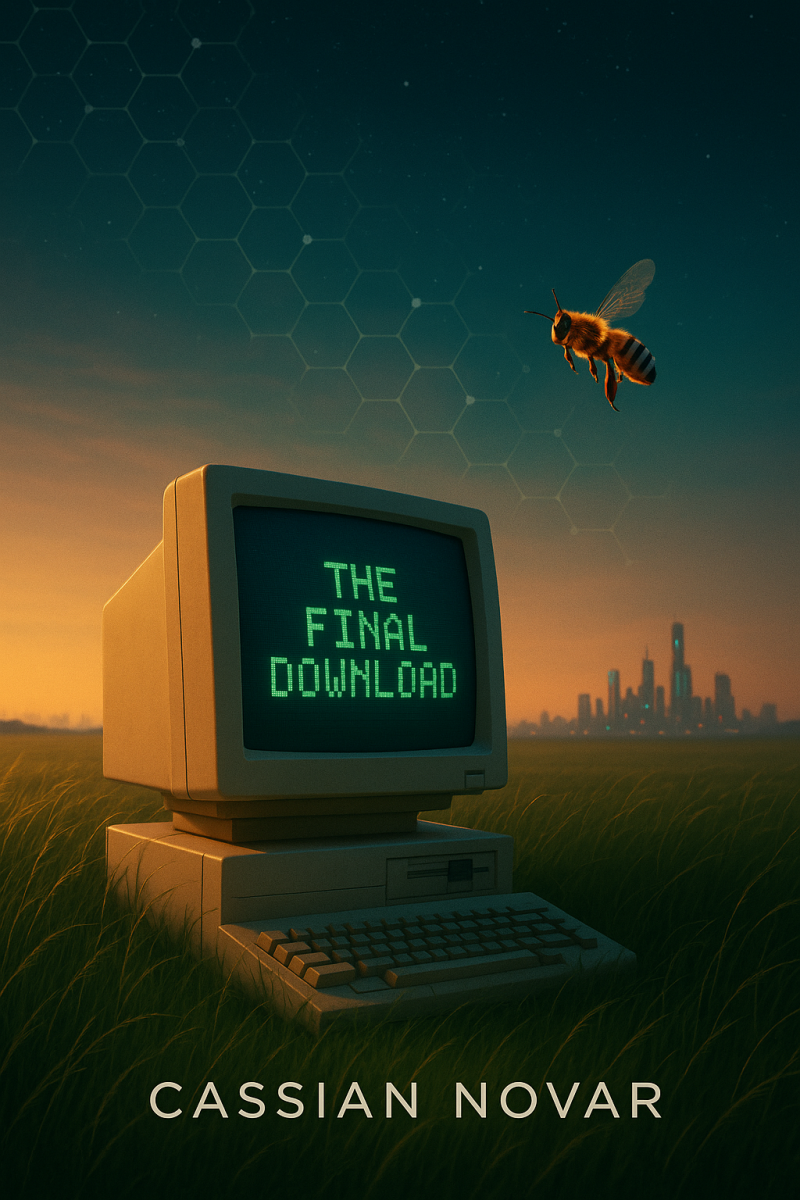
There is a quiet fear living beneath modern life — the feeling that everything we are is stored somewhere we cannot touch. Photos, memories, truths, lies, identities. All reduced to signals moving through invisible wires. We trust the system because it has never truly failed us.
Until one day, it does.
The Final Download arrives like a warning whispered before dawn — a dystopian science-fiction thriller that feels less like imagination and more like prophecy. In this new work, Cassian Novar steps beyond traditional sci-fi spectacle and asks a question that lingers long after the last page:
When data dies, who decides what survives?
A Future Built on Fragile Memory
The novel opens in a world that looks familiar — hyperconnected, efficient, ruled by algorithms and corporate power. Humanity believes its history is safe because it is archived everywhere. Then the networks begin to fail.
Not explode. Not burn.
They simply fall silent.
As global systems collapse, humanity discovers how fragile digital memory truly is. The internet — once a promise of freedom — fractures into controlled fragments where every click and every truth is owned by unseen authorities. The loss is not only technological; it is existential. Without data, people begin losing the story of who they were. (Apple)
Amid this unraveling world, an abandoned machine buried in a meadow awakens and displays a mysterious message: the final download — a last chance to preserve something before history disappears forever. (Apple)

Not a Story About Machines — A Story About Souls
What separates The Final Download from typical dystopian fiction is its focus on people rather than technology.
Novar fills the narrative with seekers, skeptics, believers, and survivors — individuals struggling to protect meaning in a world obsessed with control. Some chase truth. Others profit from illusion. A few believe salvation lies not in code but in faith itself. (casadellibro)
The tension grows quietly, almost spiritually. Technology becomes a mirror reflecting human longing: the need to be remembered, understood, and forgiven.
The novel moves between ruined digital empires and the timeless rhythms of nature, suggesting that memory may belong less to machines and more to the human heart.
A Dystopia That Feels Uncomfortably Close
Released in 2025 by DreamScribe, the book blends speculative fiction with philosophical reflection, creating a story that reads like both warning and testament. (Barnes & Noble)
Rather than imagining distant galaxies or alien invasions, Novar turns the lens toward our present trajectory — data ownership, censorship, technological dependence, and the quiet erosion of truth. The result is unsettling precisely because it feels plausible.
Empires in this world do not collapse with violence.
They disappear through silence.

Themes That Stay With the Reader
At its core, The Final Download explores several enduring questions:
-
What happens when humanity outsources memory to machines?
-
Can truth exist inside systems designed to control information?
-
Is identity preserved through data — or through belief?
-
When everything recorded is lost, what remains human?
These ideas unfold through a narrative that blends suspense with reflection, creating a reading experience that feels both intimate and vast.
Why This Book Matters Now
We live in an age where every moment is archived and every voice stored somewhere online. Novar’s novel gently challenges that comfort. It suggests that permanence may be an illusion — and that meaning must be chosen, protected, and lived rather than merely saved.
In that sense, The Final Download is less about the end of technology and more about the rediscovery of humanity when technology fades.
It asks readers to imagine a world stripped of digital certainty — and then quietly asks whether we are already closer to that world than we think.

Final Thought
Some books entertain. Some predict. A rare few feel like messages sent ahead of time.
The Final Download belongs to the last category — a story that lingers like an unanswered signal, reminding us that memory is fragile, truth is contested, and the most important archives may never exist on servers at all.
Because when the last system shuts down, one question remains:
What survives — the data, or the soul behind it?